Rediscovering Americanism by Mark R. Levin
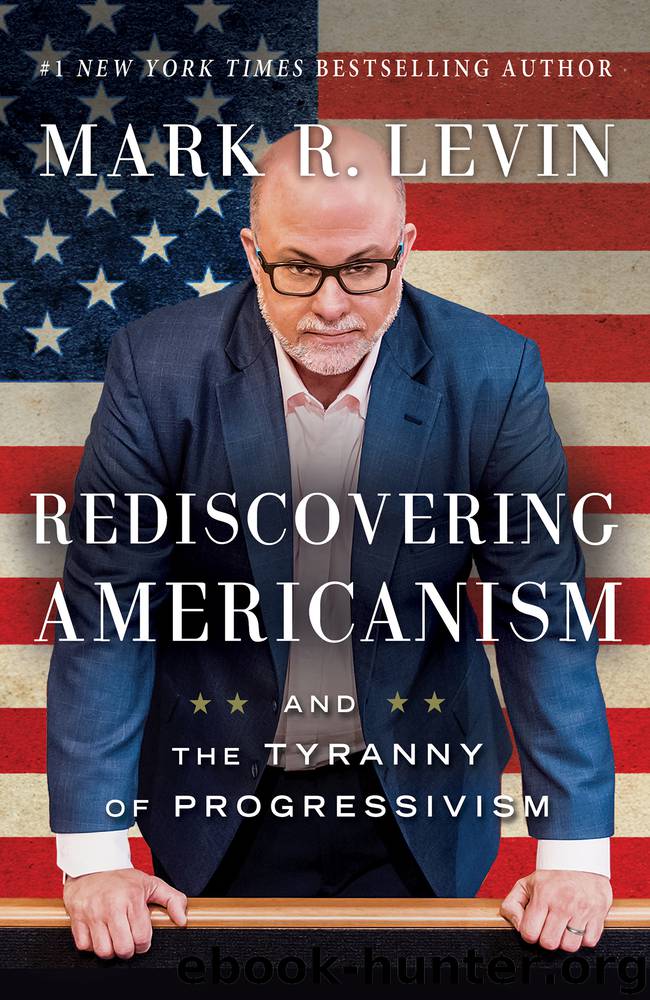
Author:Mark R. Levin
Language: eng
Format: epub
Publisher: Threshold Editions
FIVE
* * *
LIBERTY AND REPUBLICANISM
THIS LEADS US TO the next related and essential area of inquiry—what do we mean by human and individual freedom and how do we apply them in the context of what has been discussed thus far? While these issues are too large for an all-inclusive dissertation, they require concentrated treatment.
On April 4, 1819, in a letter replying to Isaac H. Tiffany, Thomas Jefferson succinctly described liberty: “Of liberty then I would say that, in the whole plenitude of its extent, it is unobstructed action according to our will: but rightful liberty is unobstructed action according to our will, within the limits drawn around us by the equal rights of others. I do not add ‘within the limits of the law’; because law is often but the tyrant’s will, and always so when it violates the right of an individual.”1 In this short statement, did Jefferson capture the essence of liberty?
Let us begin with John Stuart Mill, a distinguished British philosopher. I start here not because Mill had any influence on the Founders (an impossibility since he lived from 1806 to 1873) but because his utilitarian-libertarian writings are useful in understanding, developing, and discussing what is meant by liberty, a subject more multifaceted than one might at first imagine. Mill’s book On Liberty (1859) has been prominent since its publication. He asked: “What . . . is the rightful limit to the sovereignty of the individual over himself? Where does the authority of society begin? How much of human life should be assigned to individuality, and how much to society?” Mill answered, in part, that “every one who receives the protection of society owes a return for the benefit, and the fact of living in society renders it indispensable that each should be found to observe a certain line of conduct towards the rest. This conduct consists, first, in not injuring the interest of one another; or rather certain interests, which, either by express legal provision or by tacit understanding, ought to be considered as rights; and secondly, in each person’s bearing his share (to be fixed on some equitable principle) of the labors and sacrifices incurred for defending the society or its members from injury and molestation. . . . Nor is this all that society may do. . . . As soon as any part of a person’s conduct affects prejudicially the interests of others, society has jurisdiction over it, and the question whether the general welfare will or will not be promoted by interfering with it, becomes open to discussion. But there is no room for entertaining any such question when a person’s conduct affects the interests of no person besides himself, or needs not affect them unless they like. . . . In all such cases there should be perfect freedom, legal and social, to do the action and stand the consequences.”2
Mill explained further that his utilitarianism is not a philosophy of isolated individualism or social disinterest: “It would be a great misunderstanding
Download
This site does not store any files on its server. We only index and link to content provided by other sites. Please contact the content providers to delete copyright contents if any and email us, we'll remove relevant links or contents immediately.
| Anthropology | Archaeology |
| Philosophy | Politics & Government |
| Social Sciences | Sociology |
| Women's Studies |
The Secret History by Donna Tartt(19479)
The Social Justice Warrior Handbook by Lisa De Pasquale(12297)
Thirteen Reasons Why by Jay Asher(9134)
This Is How You Lose Her by Junot Diaz(7060)
Weapons of Math Destruction by Cathy O'Neil(6483)
Zero to One by Peter Thiel(5954)
Beartown by Fredrik Backman(5951)
The Myth of the Strong Leader by Archie Brown(5631)
The Fire Next Time by James Baldwin(5592)
How Democracies Die by Steven Levitsky & Daniel Ziblatt(5334)
Promise Me, Dad by Joe Biden(5238)
Stone's Rules by Roger Stone(5196)
A Higher Loyalty: Truth, Lies, and Leadership by James Comey(5092)
100 Deadly Skills by Clint Emerson(5032)
Rise and Kill First by Ronen Bergman(4908)
Secrecy World by Jake Bernstein(4893)
The David Icke Guide to the Global Conspiracy (and how to end it) by David Icke(4854)
The Doomsday Machine by Daniel Ellsberg(4630)
The Farm by Tom Rob Smith(4614)
